After feeding, some babies burp repeatedly, appear bloated or become fussy. This often leaves parents wondering: Is the baby swallowing too much air? Is the nipple flow unsuitable? Could changing the bottle make feeding more comfortable?
This is where anti colic baby bottles enter the conversation. This guide explains how anti-colic bottles work, how they differ from regular bottles and what parents should consider before choosing one.
What Is an Anti-Colic Bottle?
An anti-colic feeding bottle is a baby bottle designed with a dedicated vent or valve to manage airflow during feeding. Unlike a basic bottle-and-nipple setup, it includes an air-management feature as part of the feeding system.
The term “anti-colic” describes this structural design. It does not mean the bottle can eliminate every cause of gas, crying or infant colic. Different anti colic baby bottles may also use different vent structures and numbers of components.
How Do Anti-Colic Bottles Work?
To understand how anti colic bottles work, consider what happens as a baby drinks. Milk leaves the bottle through the nipple, and air must enter to replace the space previously occupied by the milk.
If air cannot enter easily, negative pressure builds inside the bottle. The baby may need to suck harder to maintain the flow. The nipple may collapse, while the milk may repeatedly slow down or stop.
An anti-colic valve or venting system gives incoming air a separate path. This helps balance the pressure inside the bottle and supports a steadier milk flow.
Common designs include:
- Nipple vent: The vent is built into the base or edge of the nipple. It usually requires fewer separate parts.
- Neck vent: The vent is positioned around the bottle neck or collar, allowing air to enter near the nipple assembly.
- Internal vent tube: A separate tube directs incoming air deeper into the bottle. This design generally contains more components.
- Bottom vent: Air enters through a valve at the bottle base, keeping the air-entry point away from the nipple.
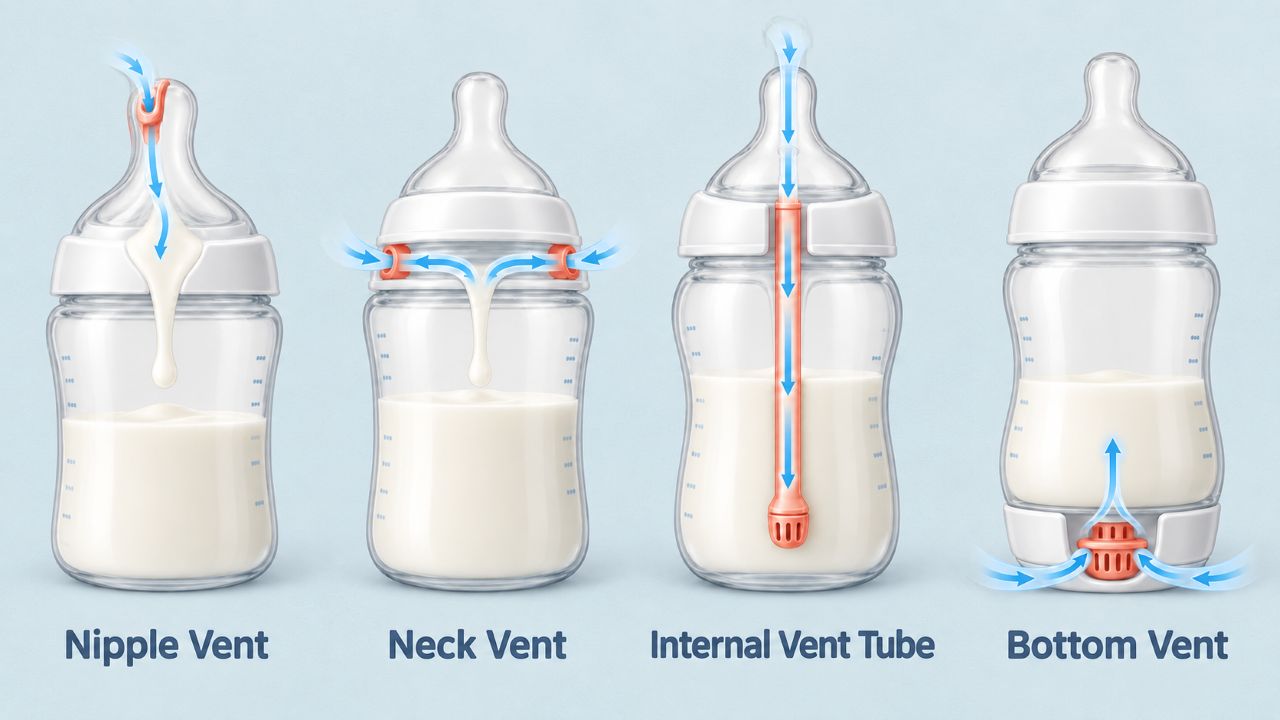
These systems follow the same basic pressure-management principle. However, they differ in component count, cleaning requirements and potential leakage points.
Anti-Colic Bottles vs Regular Bottles
The main difference is how the bottle replaces the air displaced as the baby drinks.
| Feature | Anti-Colic Bottle | Regular Bottle |
|---|---|---|
| Air entry | Uses a dedicated vent or valve | Usually relies on airflow near the nipple |
| Bottle pressure | Designed to reduce vacuum buildup | Vacuum may increase during feeding |
| Milk flow | May remain more consistent | Depends largely on nipple design |
| Parts | May contain extra valves or tubes | Usually has fewer parts |
| Cleaning | Small vents require careful cleaning | Generally simpler to clean |
| Suitable for | Babies who gulp air or experience flow interruptions | Babies already feeding comfortably |
An anti-colic bottle is not automatically better in every situation. Extra valves or tubes may make cleaning and assembly more complicated. If your baby feeds comfortably from a regular bottle without nipple collapse or obvious air gulping, switching may not be necessary.
How to Choose the Best Anti-Colic Bottle?
The best anti colic bottles combine reliable airflow with a suitable nipple, practical bottle size and manageable cleaning. Consider how the complete bottle works in daily use rather than choosing by the anti-colic label alone.
Vent Design
Compare where the vent is located and how many components the system uses. Nipple vents usually have fewer parts, while internal or bottom vents may separate the air path more clearly but add components. No single design is automatically best for every feeding routine.
Nipple Flow
Choose a nipple flow rate that matches your baby’s sucking and swallowing ability. Age recommendations provide a starting point, but feeding behavior is more useful:
- Coughing, choking or milk leaking from the mouth: The flow may be too fast.
- Hard sucking, fussiness or nipple collapse: The flow may be too slow, or the vent may be blocked.
Bottle Material
Common baby feeding bottle materials offer different practical advantages:
- PP: Lightweight and convenient for everyday use.
- PPSU: Lightweight with greater heat resistance.
- Tritan: Clear, lightweight and resistant to impact.
- Glass: Heat-resistant and less likely to retain odors, but heavier and breakable.
Capacity and Shape
Smaller newborn anti colic bottles can suit early, lower-volume feeds. Larger bottles become more practical as milk intake increases. The shape should also be comfortable to hold, fill and clean.
Cleaning and Assembly
Check whether small valves are easy to reach and whether a special brush is required. Parts should have clear assembly positions, since a blocked, missing or incorrectly installed valve may affect airflow or cause leakage. Follow the manufacturer’s instructions when cleaning and sterilizing baby bottles, especially models with small vents or removable tubes.
Source Anti-Colic Baby Bottles from OYABABIES
The OYABABIES baby feeding bottle collection includes anti-colic PP bottles in 140 ml, 160 ml and 260 ml capacities. Buyers can also choose from a broader range of PP, PPSU, Tritan and glass bottles in different sizes and shapes to build a more complete feeding product line.

Established in 2001, OYABABIES manages molding, assembly and packaging within its own factory. Its services for retailers, distributors and baby-product brands include:
- OEM and ODM support: Select an existing bottle or develop a customized model.
- Product customization: Adjust molds, materials, capacities, colors and logos.
- Private-label packaging: Create packaging suited to specific markets and retail channels.
- Production quality control: Confirm pre-production samples and inspect products before shipment.
With products supplied to more than 60 countries, OYABABIES can also support export documentation, packing and bulk-order coordination. Buyers can contact the team to compare available vent designs, nipple stages and customization requirements before requesting samples or placing an order.
FAQ
Can newborns use anti-colic bottles?
Yes. Anti colic bottles for newborns can be used when the bottle and nipple are designed for newborn feeding. Start with a slow-flow nipple and observe whether your baby can suck, swallow and pause comfortably.
How do you use an anti-colic baby bottle?
Assemble the vent as directed and check that it is clear. Hold your baby in a semi-upright position and keep the bottle nearly horizontal to control the milk flow. Clean the valve and other small parts after each feed.
Can anti-colic bottles be used for breast milk and formula?
Yes. The venting system can work with either expressed breast milk or formula. Always follow the correct storage, preparation and cleaning instructions for the type of milk used. Parents combining breast and bottle feeding can also read our guide to introducing a bottle to a breastfed baby.
When should you stop using anti-colic bottles?
There is no fixed age. You can continue using one while the bottle capacity, nipple flow and design still suit your baby’s feeding needs.
Do anti-colic bottles really help with gas and colic?
They may reduce swallowed air and feeding interruptions for some babies. However, colic has several possible causes, so an anti-colic bottle cannot guarantee that gas, crying or colic will stop.