After feeding, some babies burp repeatedly, appear bloated or become fussy. This often leaves parents wondering: Is the baby swallowing too much air? Is the nipple flow unsuitable? Could changing the bottle make feeding more comfortable?
Anti-colic baby bottles are designed to manage airflow during feeding, but the bottle is only one part of feeding comfort. This guide explains how the vents work, how these bottles compare with simpler designs and what to check when choosing one for your baby.
What Is an Anti-Colic Bottle?
An anti-colic feeding bottle is a baby bottle with a vent or valve designed to let air enter as milk leaves. The vent may be built into the nipple or use separate components inside the bottle or at its base.
“Anti-colic” is a product label, not a guarantee that a bottle will prevent gas or treat infant colic. Bottles sold under this label can differ considerably in their vent design, number of parts and cleaning requirements.
How Do Anti-Colic Bottles Work?
As a baby drinks, milk leaves the bottle through the nipple. Air must enter to replace it.
If air cannot enter easily, negative pressure builds inside the bottle. The baby may need to suck harder to maintain the flow. The nipple may collapse, while the milk may repeatedly slow down or stop.
An anti-colic valve or venting system provides a route for replacement air to enter. This is intended to limit vacuum buildup and help milk flow more steadily. The route the air takes depends on the bottle’s design; not every vent keeps incoming air separate from the milk.
Common designs include:
- Nipple vent: The vent is built into the base or edge of the nipple. It usually requires fewer separate parts.
- Neck vent: The vent is positioned around the bottle neck or collar, allowing air to enter near the nipple assembly.
- Internal vent tube: A separate tube routes incoming air through the bottle. Its operation and correct feeding position depend on the model.
- Bottom vent: Air enters through a valve at the bottle base, keeping the air-entry point away from the nipple.
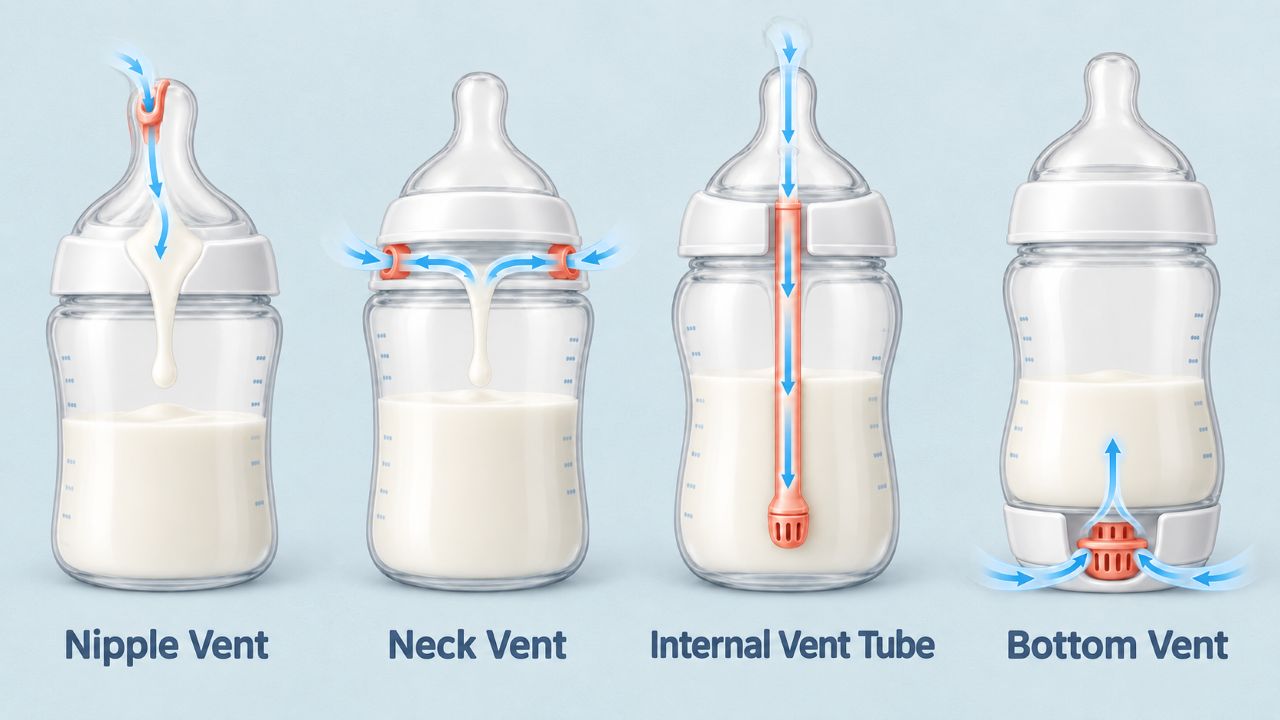
These systems share a pressure-management purpose, but their assembly and maintenance requirements vary. Follow the instructions for the specific model rather than assuming all anti-colic bottles work in the same way.
Anti-Colic Bottles vs Regular Bottles
The distinction is not always clear: some bottles with a simple nipple vent are also marketed as anti-colic. Here, “regular bottle” means a basic bottle without a dedicated venting feature. Compare the actual components rather than relying on the label alone.
| Feature | Anti-Colic Bottle | Regular Bottle |
|---|---|---|
| Air entry | Uses a dedicated vent or valve | Usually relies on airflow near the nipple |
| Bottle pressure | Designed to reduce vacuum buildup | Vacuum may increase during feeding |
| Milk flow | May remain more consistent | Depends largely on nipple design |
| Parts | May contain extra valves or tubes | Usually has fewer parts |
| Cleaning | Small vents require careful cleaning | Generally simpler to clean |
| Suitable for | Babies who gulp air or experience flow interruptions | Babies already feeding comfortably |
An anti-colic bottle is not automatically better in every situation. Extra valves or tubes may make cleaning and assembly more complicated. If your baby feeds comfortably from a regular bottle without nipple collapse or obvious air gulping, switching may not be necessary.
How to Choose the Best Anti-Colic Bottle for Your Baby?
The best anti-colic bottles for your baby are those that suit their feeding ability and are straightforward for you to assemble and clean. Start with nipple flow and practical use rather than choosing by the anti-colic label alone.
Vent Design and Gas Concerns
If you are looking for the best bottles to prevent gas, compare how each vent works and how easily it can be cleaned. No bottle can guarantee gas-free feeds. Also check the nipple flow, how your baby attaches to the nipple and whether the feeding pace is comfortable.
A built-in valve may suit parents who prefer fewer parts. A separate vent system adds components to inspect and assemble. Choose a design you can use correctly at every feed.
Nipple Flow
Choose a nipple flow rate that matches your baby’s sucking and swallowing ability. Age recommendations provide a starting point, but feeding behavior is more useful:
- Coughing, choking or milk leaking from the mouth: The flow may be too fast.
- Hard sucking, fussiness or nipple collapse: Check for a blocked vent, incorrect assembly or an unsuitable nipple flow rather than automatically moving to a faster nipple.
Bottle Material
Common baby feeding bottle materials offer different practical advantages:
- PP: Lightweight and convenient for everyday use.
- PPSU: Lightweight and commonly used in bottles designed for repeated heat sterilization.
- Tritan: Clear, lightweight and resistant to impact.
- Glass: Less likely to retain odors, but heavier and breakable.
Material alone does not determine anti-colic performance. Check the manufacturer’s temperature limits and approved cleaning and sterilization methods for the complete bottle, including its nipple and valves.
Capacity and Shape
Smaller newborn anti colic bottles can suit early, lower-volume feeds. Larger bottles become more practical as milk intake increases. The shape should also be comfortable to hold, fill and clean.
Cleaning and Assembly
Check whether small valves are easy to reach and whether a special brush is required. Parts should have clear assembly positions, since a blocked, missing or incorrectly installed valve may affect airflow or cause leakage. Follow the manufacturer’s instructions when cleaning and sterilizing baby bottles, especially models with small vents or removable tubes.
Source Anti-Colic Baby Bottles from OYABABIES
For retailers, distributors and baby-product brands, bottle selection also involves comparing specifications, replacement parts and customization options.
The OYABABIES baby feeding bottle collection includes anti-colic PP bottles in 140 ml, 160 ml and 260 ml capacities. Buyers can also choose from a broader range of PP, PPSU, Tritan and glass bottles in different sizes and shapes to build a more complete feeding product line.

Established in 2001, OYABABIES manages molding, assembly and packaging within its own factory. It offers OEM and ODM support, product customization and private-label packaging for wholesale buyers.
Before requesting samples, ask the team to confirm:
- Venting structure: Vent location, component count and assembly instructions for the selected model.
- Nipple options: Supplied nipple, available flow stages and compatibility with replacement nipples.
- Product care: Approved cleaning and sterilization methods and replacement-part availability.
- Order requirements: Minimum order quantity, sample arrangements, lead time and logo or packaging options.
Contact the team with your target market, preferred capacity and customization requirements to discuss suitable models and request samples.
FAQ
Can newborns use anti-colic bottles?
Yes, provided the bottle and nipple are intended for newborn feeding. Start with the manufacturer’s recommended newborn nipple and watch your baby’s feeding behavior. If feeding remains difficult, ask a healthcare professional to assess the feed rather than repeatedly changing bottles or nipple sizes.
How do you use an anti-colic baby bottle?
Assemble the vent as directed and check that it is clear. Hold your baby semi-upright with their head supported. Keep the bottle nearly horizontal, tipped enough to keep milk in the nipple, and follow any model-specific instructions for vent positioning. Allow pauses and stop when your baby shows they have had enough. Clean all parts after each feed and sterilize them as recommended.
Can anti-colic bottles be used for breast milk and formula?
Yes. The venting system can work with either expressed breast milk or formula. Always follow the correct storage, preparation and cleaning instructions for the type of milk used. Parents combining breast and bottle feeding can also read our guide to introducing a bottle to a breastfed baby.
When should you stop using anti-colic bottles?
There is no fixed age for switching from an anti-colic bottle to another bottle design. However, this is different from deciding when to stop bottle feeding. The NHS recommends introducing a cup from around six months and discouraging bottle feeding after one year. Follow local guidance and your baby’s individual feeding needs.
Do anti-colic bottles really help with gas and colic?
Anti-colic bottles are designed to manage airflow and limit vacuum buildup during feeding. That design purpose does not establish that a bottle prevents gas or treats colic. The NHS notes that there is no evidence that one type of bottle or nipple is better than another. Choose a bottle your baby can feed from comfortably and that you can clean properly. Seek feeding advice if discomfort or feeding difficulties persist.