A first-time parent on Reddit asked a question many families have before bottle feeding: “Do I put everything into boiling water, and do I need to sterilize after every use?”
The short answer is that bottles, nipples, rings, caps and removable valves should all be taken apart and cleaned after every feeding. Whether they also need daily sterilizing depends on your baby’s age, health and the guidance followed in your country.
This guide explains how to clean baby bottles properly and how to sterilize them using boiling water, a microwave, a steam sterilizer or a cold-water solution.
Cleaning vs. Sterilizing Baby Bottles
Cleaning removes milk, formula residue and visible dirt, while sterilizing—or sanitizing, as the CDC calls it—provides an additional level of germ removal. Bottles must always be cleaned before they are sterilized because milk residue can prevent the sterilizing process from reaching every surface.
| Process | Purpose | How Often? |
|---|---|---|
| Cleaning | Removes milk, formula residue and visible dirt | After every feeding |
| Sterilizing or sanitizing | Provides additional germ removal after cleaning | Depends on the baby’s age, health and local guidance |
How to Clean Baby Bottles?
1. Cleaning Baby Bottles by Hand
The CDC’s infant feeding item guidance recommends the following steps:
- Wash your hands and separate the bottle, nipple, ring, cap and valves.
- Rinse each component under running water.
- Place the parts in a clean basin used only for feeding equipment.
- Wash them with hot water, dish soap and a dedicated bottle brush.
- Clean nipple holes and removable parts carefully, especially the small valves used in anti-colic baby bottles, where milk may collect.
- Rinse thoroughly and leave all parts to air-dry.
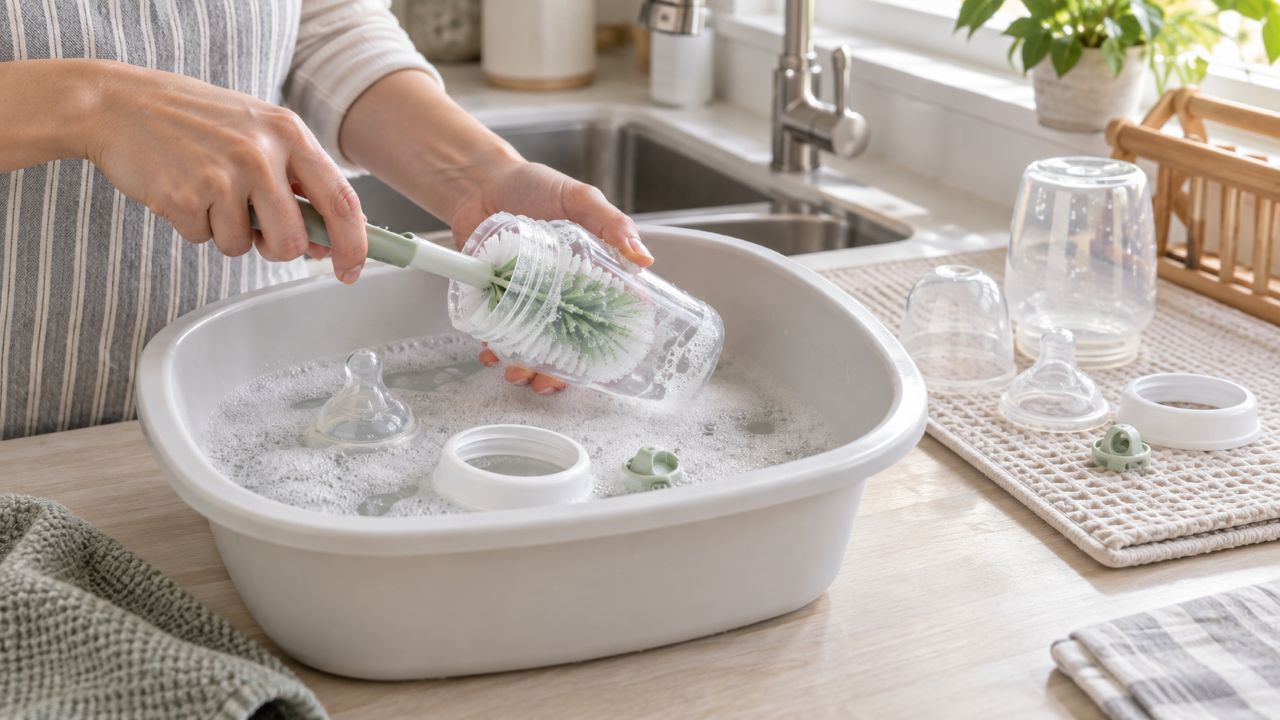
Avoid washing bottles directly in the kitchen sink. The CDC also advises allowing parts to air-dry rather than rubbing them with a dish towel, which could transfer germs back onto clean equipment.
Some parents clean bottles after each feeding, while others keep enough for several feeds and wash them together. Your preferred routine can therefore help determine how many baby bottles you need.
2. Can You Wash Baby Bottles in the Dishwasher?
Yes, provided every component is marked dishwasher-safe. Take the bottle apart, rinse away visible milk and place nipples, valves and other small parts in a closed dishwasher basket.
How to Sterilize Baby Bottles?
Because different baby bottle materials tolerate heat differently, check that every component is compatible with the selected sterilizing method.
1. How to Sterilize Baby Bottles in Boiling Water on the Stove?
Boiling is the simplest way to sterilize baby bottles without a sterilizer.
Place the disassembled, heat-safe parts in a large pot and cover them completely with water. Remove trapped air and keep every item below the surface while boiling.
Recommended boiling times differ between official health authorities:
- The CDC recommends boiling feeding equipment for five minutes.
- The NHS recommends boiling it for at least ten minutes.
Follow the bottle manufacturer’s instructions and the health guidance used in your country. Remove the parts with clean tongs and leave them to air-dry.
Note that repeated boiling can damage nipples more quickly. Replace any component that becomes cracked, torn, sticky or misshapen.
2. How to Sterilize Baby Bottles in the Microwave?
Microwave steam systems are an accepted sanitizing method when they are used according to the manufacturer’s instructions.
Use a microwave sterilizing bag or container designed for infant feeding equipment. Add the specified amount of water, load the pre-cleaned parts and follow the instructions for microwave power, cycle time and cooling.
Do not microwave bottles directly or improvise with a random sealed container. If you need to sterilize baby bottles in a microwave without a countertop sterilizer, use a purpose-made microwave bag or steam container.
3. How to Sterilize Baby Bottles With a Sterilizer?
Electric and microwave sterilizers use steam to sanitize bottles and accessories. Add the specified amount of water and position the parts so steam can reach every surface.
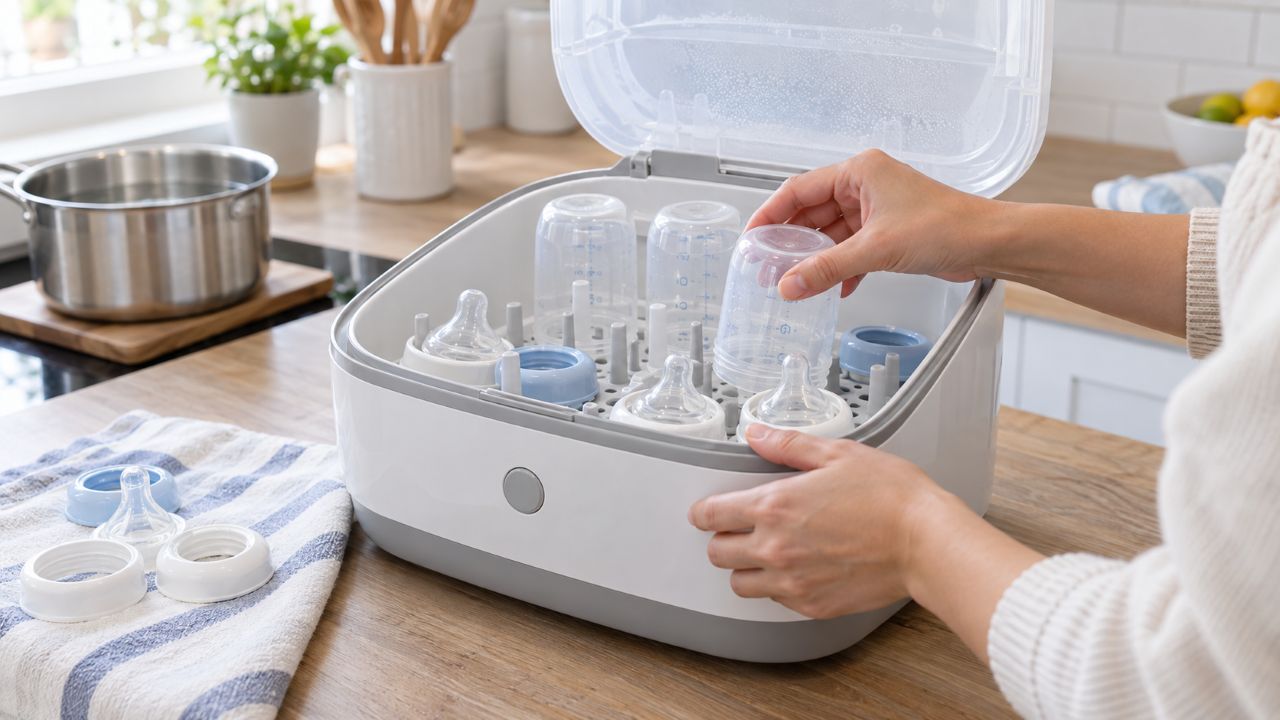
Follow the sterilizer manufacturer's instructions, as sterilization times and loading requirements vary depending on the equipment. Avoid overloading the unit and do not stack or nest components.
4. How to Sterilize Baby Bottles With a Cold-Water Solution?
Cold-water sterilizing solution is useful while traveling or when heat-based methods are unavailable.
Use a product made specifically for infant feeding equipment. Submerge every component, remove trapped air bubbles and keep all parts below the surface.
The NHS recommends soaking feeding equipment for at least 30 minutes and replacing the solution every 24 hours. Follow the product instructions regarding concentration, rinsing and safe disposal.
How Long Do You Need to Sterilize Baby Bottles?
How long to sterilize baby bottles depends on the method you use.
| Method | Typical Time |
|---|---|
| Boiling | 5 minutes under CDC guidance; at least 10 minutes under NHS guidance |
| Microwave steam bag | Usually a few minutes; follow the package |
| Electric or microwave sterilizer | Follow the device instructions |
| Cold-water solution | At least 30 minutes under NHS guidance |
| Dishwasher | One complete hot wash and heated-dry or sanitizing cycle |
Preparation, heating and cooling time will make the entire process longer than the treatment time shown above.
How Often Should You Sterilize Baby Bottles?
Baby bottles must be cleaned after every feeding, but the recommended sterilizing frequency differs between health authorities.
| Guidance | Recommendation |
|---|---|
| CDC | Sanitize at least once daily if the baby is younger than two months, was born prematurely or has a weakened immune system. Daily sanitizing may not be necessary for an older, healthy baby when bottles are cleaned thoroughly after every use. |
| NHS and HSE | Continue sterilizing bottle-feeding equipment until the baby is at least 12 months old. |
Follow the health guidance in your country. Ask your pediatrician for individual advice if your baby is premature or has a condition that affects the immune system.
When Can You Stop Sterilizing Baby Bottles?
There is no universal stopping age because official recommendations vary by country. Once routine sterilizing is no longer required under the guidance you follow, continue to disassemble, wash and air-dry every bottle after each feeding.
FAQ
Do new baby bottles need to be sterilized?
Sterilize new bottles and nipples before their first use, following the manufacturer’s instructions. New packaging does not mean the components are ready for feeding.
Should nipples and caps be sterilized too?
Yes. Disassemble and clean all parts that contact milk, formula or the baby’s mouth, including nipples, rings, caps, valves and membranes. Confirm that each part is suitable for the selected method, and replace damaged nipples with the correct baby bottle nipple size and flow rate.